
| Article Update | What Changed? |
| 9/29/2026 | Added filtering functionality for Division filters. |
| 8/27/2026 | Added breakdown information on the export report including all underlying CORs and relevant days aging data. |
| 6/4/2026 | Added functionality to click through days aging to see underlying CORs in each days aging log cell. |
Table of Contents
Overview
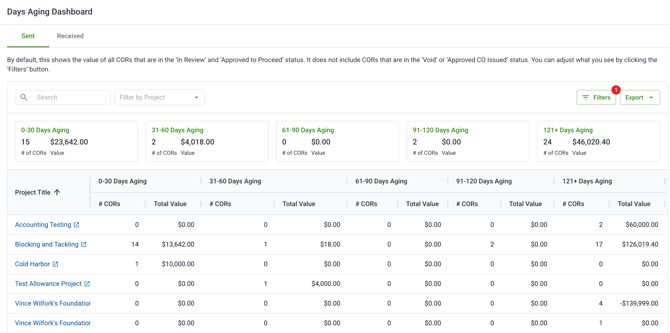
The Days Aging Report shows you how long open Change Order Requests (CORs) have been waiting for resolution, organized by project. Instead of opening each project individually to check aging, you get a single cross-project view that surfaces which projects have the oldest outstanding change orders and how much dollar exposure is sitting in each aging range.
What you see depends on your role. Account Owners see aging data across the entire company. Admins see aging data for projects in their office. Project Managers see aging data for their assigned projects. Field Users do not have access to the Days Aging Report.
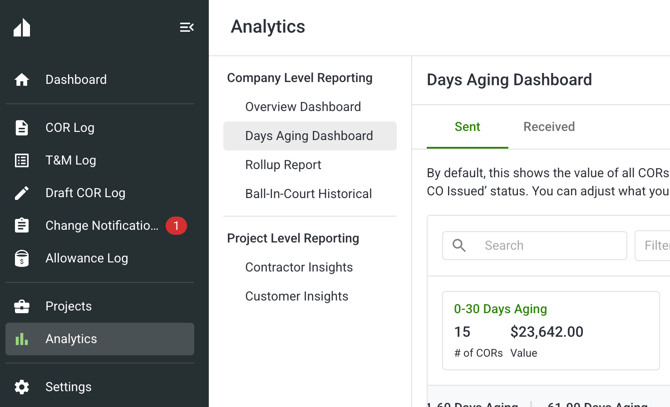
You can access the Days Aging Report from the Analytics section of the Clearstory side panel.
Why it matters
Change orders that sit unresolved for weeks or months create financial and schedule risk. The Days Aging Report helps you catch that risk early — before a 30-day COR becomes a 90-day COR — and gives you a direct path to the specific CORs that need attention.
How it works
The report is organized into two main sections.
Summary cards at the top of the page show the total count and dollar value of open CORs across all visible projects, broken down by aging range. There is one card per aging bucket: 0–30 days, 31–60 days, 61–90 days, 91–120 days, and 120+ days.
The project table lists each project as a row, with aging buckets as columns. Each cell shows the number of open CORs and their total requested value for that project within that aging range. You can click on a project name to open the COR Log for that project, pre-filtered to open COR statuses.
Both sections update automatically when you apply filters.
What counts as "aging"
Days Aging tracks how long a COR has been in an open state — meaning In Review or Approved to Proceed. Aging starts from the date the COR was submitted.
-
In Review: Aging counts actively every day.
-
Approved to Proceed: Aging continues until a formal Approved CO is issued.
-
Approved CO Issued: The COR is resolved and excluded from the aging report.
-
Void: The COR is resolved and excluded from the aging report.
Step-by-step instructions
Navigate to the Days Aging Report
-
Open Clearstory and go to the Analytics section in the side panel.
-
Select Days Aging from the Analytics navigation.
-
The report loads automatically based on your role and access level.
Read the report

-
Review the summary cards at the top of the page to understand your total aging exposure across all accessible projects by time range.
-
Scan the project table to identify which projects have the most CORs or the highest dollar value sitting in longer aging buckets (61–90, 91–120, or 120+ days).
-
Use the count and value in each cell to prioritize which projects need follow-up first.
Apply filters
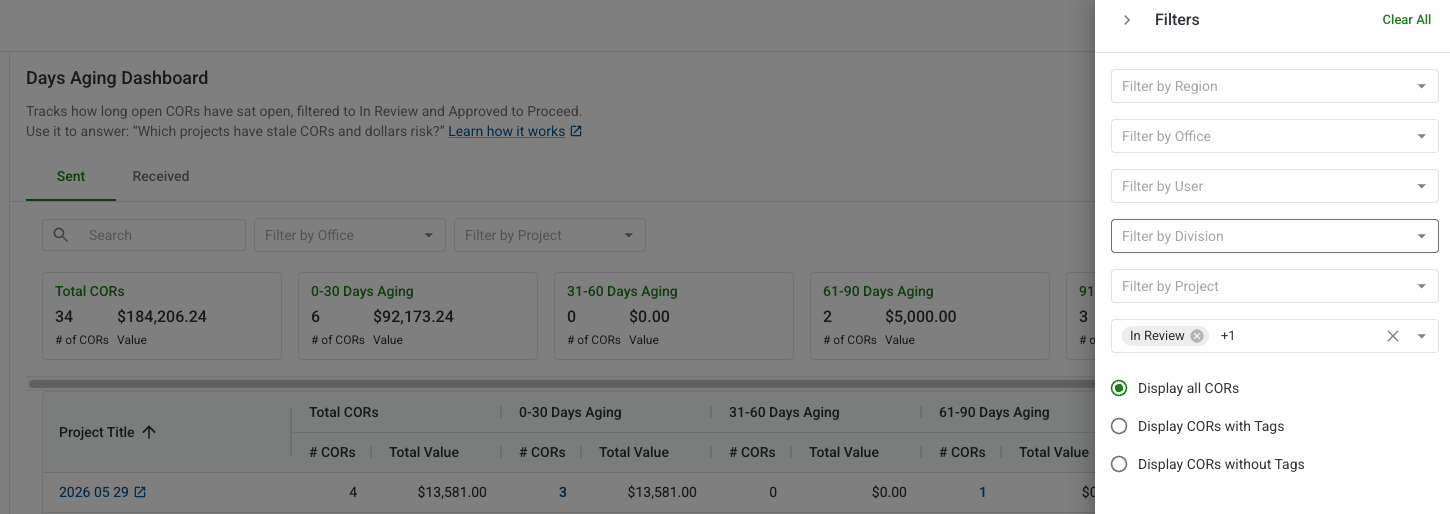
You can narrow the report to a specific segment using the filter bar at the top of the page.
Note: Filter options are scoped to your role. Admins can only filter within their office. Project Managers can only filter within their assigned projects.
-
Open the Days Aging Report.
-
Use the filter bar to select one or more of the following filters:
-
Region
-
Office
-
User
- Division
-
Project
-
Has Tags (filter to CORs that have associated T&M Tags)
-
-
The summary cards and project table update in real time as you apply filters.
-
To remove a filter, clear it individually or use the option to clear all active filters at once.
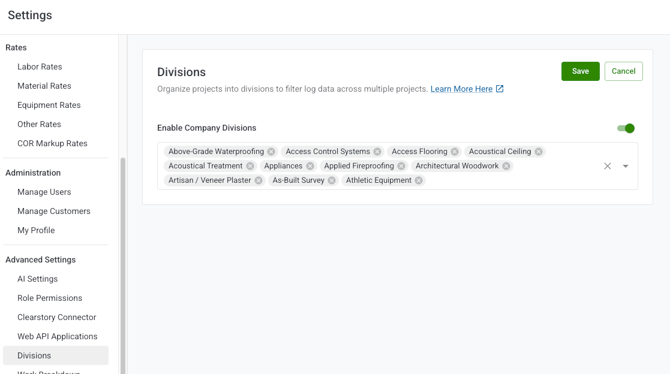
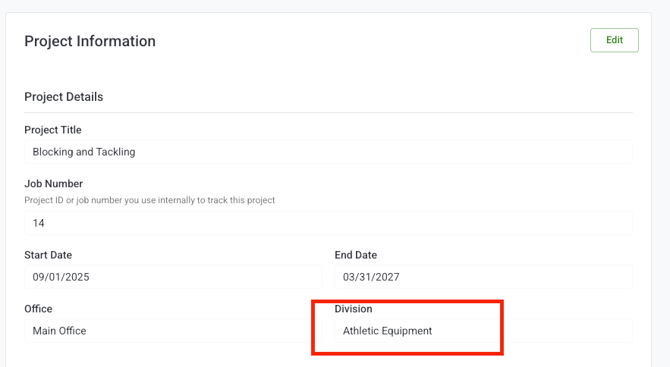
Note: Divisions must be enabled and added at the company level and then included at the project's Division section of project information to be filterable. You can learn more about your division configuration at: https://knowledge.clearstory.build/how-to-create-divisions
Drill into the COR Log
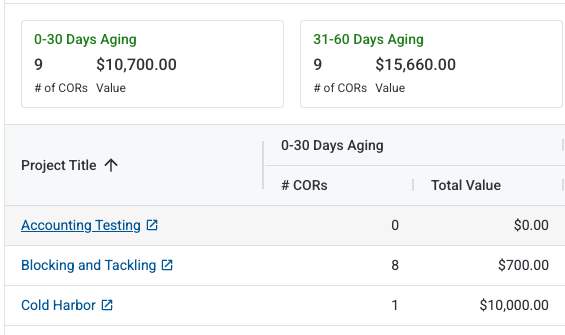
When you identify a project or aging bucket that needs attention, you can navigate directly into the COR Log to see the individual CORs behind the numbers.
-
In the project table, click on a project name.
-
Clearstory opens the COR Log in a new tab, pre-filtered to that project and open COR statuses (In Review and Approved to Proceed).
-
Review the specific CORs contributing to the aging exposure.
-
Take action — follow up, escalate, or update status — directly from the COR Log.
Note: Your active Days Aging Report filters carry over into the COR Log view.
View the CORs behind any aging count
You no longer have to leave the Days Aging Report to see which change orders are driving a number. Any non-zero COR count in an aging bucket column (0–30, 31–60, 61–90, 91–120, 120+ days) is now clickable.
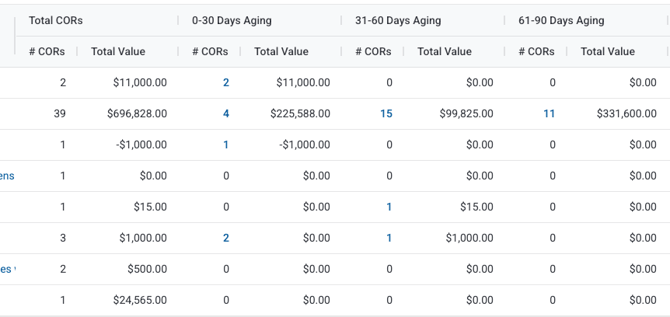
To see the underlying CORs:
- On the Days Aging Report, find the aging bucket count you want to investigate. Counts with at least one COR appear as blue, clickable links; counts of zero are not clickable.
- Click the count. A dialog opens listing every COR that makes up that number, for that project and aging bucket.
- Review the CORs in the list. Each row shows the project, COR number and title, customer reference number, current requested total, days aging, aging bucket, date submitted, status and stage, and reason category.
- Click a COR title to open that COR's detail page in a new tab.
This works the same way in Contractor Insights clicking a count there opens the same dialog, scoped to the specific contract you're viewing. It's available on both the Received and Sent versions of the report.
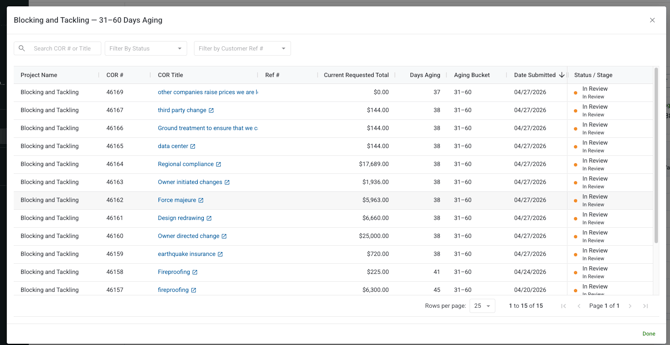
Narrow the list inside the dialog
Once the dialog is open, you can focus the list further without closing it:
- Search by COR number or title.
- Filter by status to match the COR stages you care about.
- Filter by customer reference number to isolate a specific reference.
Export the report
You can export the Days Aging Report to PDF, Excel (.xlsx), or CSV for use in external meetings, leadership reviews, or shared reporting. All three formats reflect your active filters at the time of export.
- Open the Days Aging Report.
- Apply any filters you want reflected in the export.
- Click the Export button.
- Select PDF, Excel (.xlsx), or CSV.
- Clearstory processes the export in the background. You will receive a notification when your file is ready to download.

What's in the export:
- PDF — a formatted version of the on-screen report, including your active filters and aging bucket summary.
- Excel (.xlsx) — a two-sheet workbook. Sheet 1 is the summary report matching what you see on screen. Sheet 2 contains the underlying COR detail — one row per COR, with columns for COR number, title, project, contract, days aging, aging bucket, date submitted, status, current requested total, customer reference number, and reason category.
- CSV — same column structure and data as the Excel export.
Note: If an export fails, Clearstory will notify you so you can try again. Exports are available for both the company-level and Contractor Insights reports, and for both Sent and Received COR contexts.
What each role can see
|
Action |
Account Owner |
Admin |
Project Manager |
Field User |
|---|---|---|---|---|
|
View Days Aging Report |
✅ |
✅ |
✅ |
❌ |
|
See company-wide aging data |
✅ |
❌ |
❌ |
❌ |
|
See office-level aging data |
✅ |
✅ |
❌ |
❌ |
|
See assigned project aging data |
✅ |
✅ |
✅ |
❌ |
|
Apply filters |
✅ |
✅ |
✅ |
❌ |
|
Drill into the COR Log |
✅ |
✅ |
✅ |
❌ |
|
Export (Excel) |
✅ |
✅ |
✅ |
❌ |
Tips and best practices
Focus on the 91–120 and 120+ day buckets first. CORs in these ranges represent the highest unresolved risk and are most likely to need escalation or direct follow-up with your customer or contractor.
Use the Has Tags filter to isolate CORs with associated T&M Tags. This can help you focus on changes that have field documentation tied to them and may be more time-sensitive to resolve.
Apply an Office or Project filter before exporting. A filtered export is easier to share with a specific project team or office leader than a full company-wide file.
Check that Days Aging values match what you see in the COR Log. The aging calculation is the same in both places — if a number looks off, filtering to that specific project in the COR Log is the fastest way to investigate.
Use the Excel export's detail sheet to share specific COR lists. The second sheet in the Excel export contains the same underlying COR data you'd see in the drill-down dialog — making it easy to paste a filtered list of aging CORs directly into a meeting agenda or owner report without any manual copying.
FAQs
Who can access the Days Aging Report?
Account Owners, Admins, and Project Managers can access the report. Field Users do not have access. The report is also a licensed feature — if your company's plan doesn't include company-level analytics, you will see an upgrade prompt instead of the report.
Why do I see different data than a colleague?
What you see is scoped to your role. Account Owners see all projects. Admins see projects in their office only. Project Managers see only the projects they are assigned to.
What CORs are included in the aging count?
Only open CORs are included — those in In Review or Approved to Proceed status. CORs that have reached Approved CO Issued or Void status are resolved and excluded from the report.
Does Approved to Proceed count as aging?
Yes. A COR in Approved to Proceed status is still considered open because a formal Approved CO has not yet been issued. Aging continues until that happens.
Why might a COR show an unexpected Days Aging value?
Older CORs that reached Approved CO Issued status before the Approved CO Issued Date field was introduced may be missing that date. If the date is missing, Days Aging for those records may not be accurate. This is a known limitation for legacy records.
Do filters apply to both the summary cards and the project table?
Yes. Applying a filter updates both the summary cards at the top of the page and the project table at the same time.
Can I export a filtered view?
Yes. Exports always reflect your active filter selections. Apply your filters first, then click Export.
What export formats are available?
The Days Aging Report exports to PDF, Excel (.xlsx), and CSV. Excel and CSV exports include two sheets — a summary view matching the on-screen report, and a detail sheet with one row per underlying COR. All formats reflect your active filters, and both Sent and Received COR contexts are supported.